There are now so many AI tools promising to fix your resume that it has become its own kind of noise.
TikTok prompt libraries. Free government-backed career chatbots. Open-source pipelines with 50,000 GitHub stars. Resume rewriters, keyword injectors, ATS optimisers. All of them promising the same thing: paste your resume, paste the job description, get a better resume back in seconds.
I tried a few of them. And I want to be honest about what I found. Not to trash any tool, but because I think there is a real and important distinction being glossed over in all this noise. A distinction that matters a lot if you are a mid-career professional applying for a senior role.
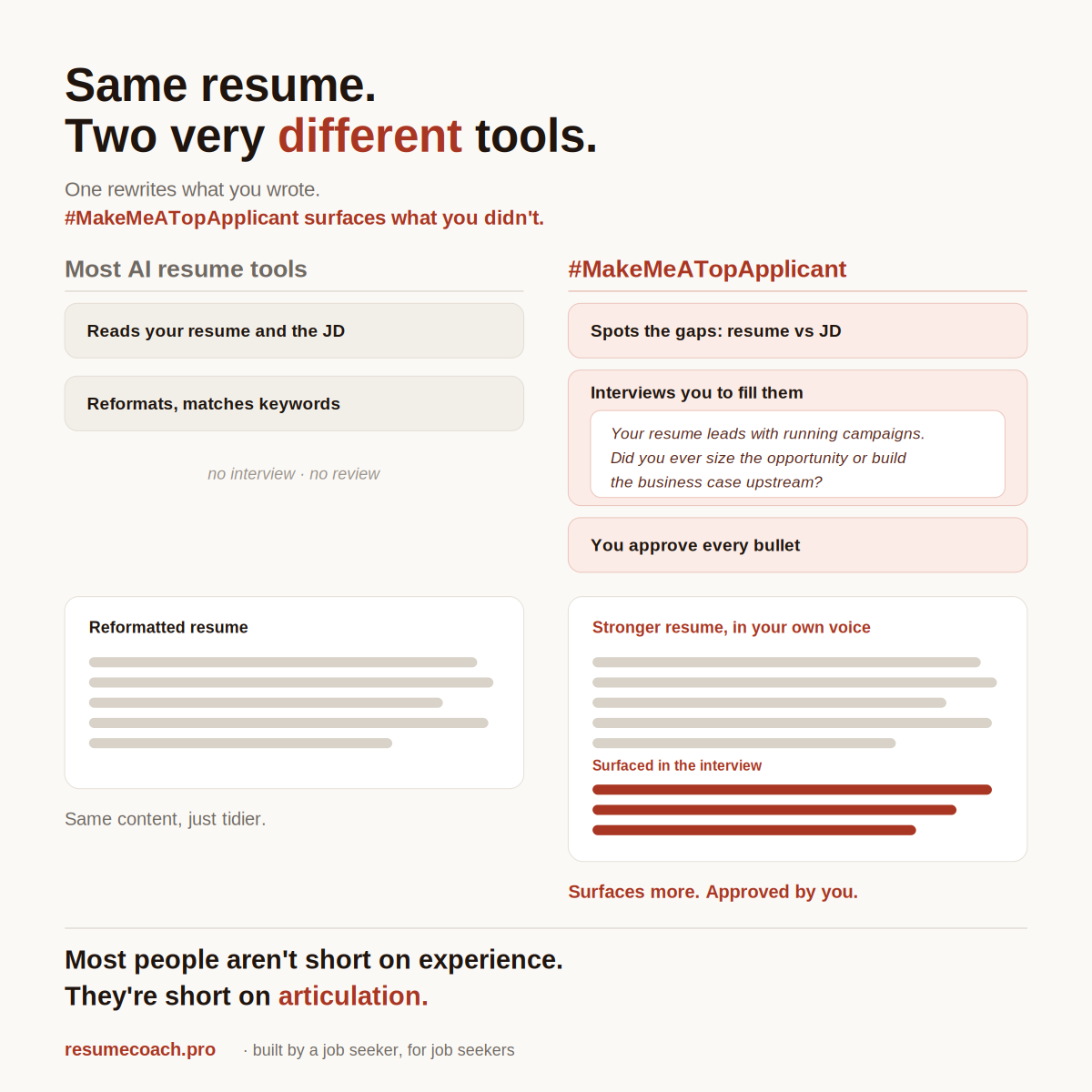
Same resume in. Two very different tools.
The thing most AI resume tools actually do
Here is what the majority of these tools have in common, regardless of how they are packaged.
You provide a resume. You provide a job description. The AI reads both, identifies keyword gaps, and rewrites your resume to close those gaps. It might ask a few clarifying questions about industry or seniority. Then it produces a tailored output, usually formatted to pass ATS filters.
That sounds useful. And for a certain type of job seeker, it genuinely is.
If you are early in your career, your resume mostly reflects your actual experience. The gap between what is on your resume and what you have done is small. A quick rewrite, better keywords, cleaner formatting: that gets you pretty far.
But here is what that approach cannot do.
It cannot surface experience that is not on your resume.
If you managed a cross-functional launch that touched clinical data, but your resume describes it as "stakeholder coordination," an AI rewriter will not know to bridge that gap. It will work with what you wrote, not what you actually did.
If you led a market access initiative but called it "go-to-market strategy" because that was the language your company used at the time, the AI rewriter will not flag that the job description's "market access" requirement is exactly what you did. It will just note the gap and move on.
This is what I call the content ceiling. Every AI tool that starts from your existing resume is bounded by it. Better formatting, same ceiling.
Why an interview changes everything
When I built MMATA, the core idea was simple: do not start by rewriting. Start by asking.
Before a single word of a new resume gets written, the AI reads your resume and the job description together, identifies the gaps, and then interviews you about them. Not generic questions like "tell me about your experience." Targeted probes.
"The job description asks for clinical trial experience. You have not listed that explicitly. Have you worked with clinical data, study results, or cross-functional teams that touched clinical programmes?"
Sometimes the answer is no. That is a real gap and it gets handled honestly.
But often, the answer is: "Actually, yes. I just never described it that way."
That is the moment most AI resume tools miss entirely. The experience existed. It just was not on the resume in the right language. The interview surfaces it.
The conversation is in plain language. You do not need to know how to write a prompt. You just answer questions about your own work history, the same way you would with a career coach. MMATA guides you through it.
The honest limitation
I want to be upfront about what MMATA is not.
It is not a 20-second fix. It is not a passive tool you upload a file into and walk away from.
It requires you to show up for the conversation. To think back. To answer questions about work you may not have written down in years. That takes maybe 20 to 30 minutes of genuine engagement.
For someone who wants to send the same resume to 40 jobs this week, MMATA is not the right tool. I will say that plainly.
But for someone who has one or two roles they genuinely want, who knows their experience is stronger than their resume suggests, and who wants to make sure nothing relevant gets left on the table: that 20 to 30 minutes is the whole point.
The interview is not a hurdle. It is the product.
What this means for your job search
Most job seekers are not short on experience. They are short on articulation.
The gap is not between what they have done and what the job requires. The gap is between what they have done and what their resume says they have done.
An AI that rewrites what you gave it cannot close that gap. It can only work with what it was handed.
An AI that interviews you first, and then writes, can close it.
That is the only distinction that matters. Everything else: the formatting, the keyword matching, the ATS compliance: those are table stakes. They matter, but they do not differentiate a resume. They just make sure it gets seen.
What makes a resume competitive is the content. And the content is only as good as the process that surfaced it.
If you want the story behind why I built it this way, that is worth reading next: I was retrenched twice before 50. Here's what I built the second time around.
If you want the fuller breakdown of when a quick AI prompt is enough and when it is not, that is worth reading too: Why your resume doesn't show everything you've done, and what to do about it.
If you want to try the interview-first approach, one complete session is free at https://www.resumecoach.pro. No credit card required. See if the conversation surfaces something your current resume is missing.
If it does not, at least you will know your resume already reflects everything you have. That is worth knowing too.
EY